
Non-fiction book reviews

John Douglas is a former FBI Special Agent and expert in criminal profiling and behavioural science. He made a career of looking evil in the eye – and understanding it. No wonder that he was the inspiration for Special Agent Jack Crawford in The Silence of the Lambs, as well as the film’s consultant on the reality of serial killers.
Douglas invented and established the practice of criminal profiling, and submerged himself in the world of serial killers in a quest to understand why they killed, and to help prevent more innocent lives from being ended by future killers.
As his serial crime unit developed from a derided two-bit operation in a dingy officer to one of the FBI’s elite task forces, Douglas personally confronted the most terrible crimes of the age, including those of Jeffrey Dahmer, Charles Manson, Ted Bundy and the Atlanta child murderer.
With the fierce page-turning power of a bestselling novel, yet terrifyingly true, Mindhunter is a true crime classic.
If you have stepped foot into the true crime space, you probably know John Douglas’s name – he’s an incredibly important figure in the development of criminal profiling and one of the people responsible for the concept and classification of serial killers. I’ve always been interested in behavioural science (yes, I was a Criminal Minds addict) and wanted to learn a little more about Douglas and the unit he worked with.
This book wasn’t exactly what I wanted it to be, which isn’t really his fault. I was hoping more for a first-hand history of the Behavioural Science Unit and the now-famous serial killer interviews the unit conducted. While there was a bit of that, this book is mostly a collection of anecdotes of John Douglas’s time hunting various criminals. You do get the distinct impression that John Douglas’s biggest fan is John Douglas himself – yikes. Mindhunter was an interesting but ultimately forgettable read.
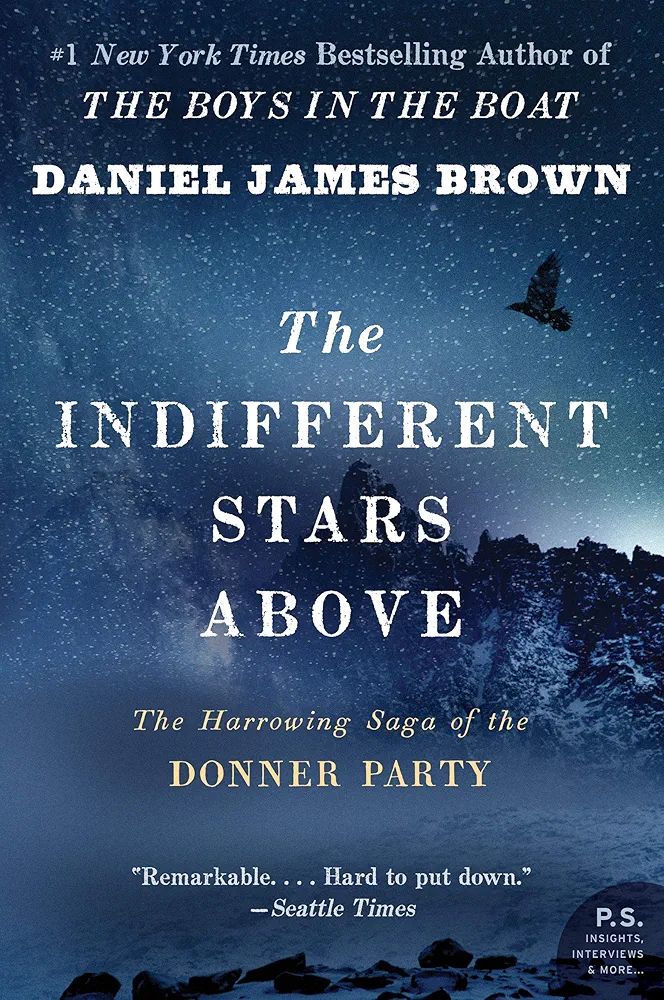
In April of 1846, twenty-one-year-old Sarah Graves, intent on a better future, set out west from Illinois with her new husband, her parents, and eight siblings. Seven months later, after joining a party of pioneers led by George Donner, they reached the Sierra Nevada Mountains as the first heavy snows of the season closed the pass ahead of them. In early December, starving and desperate, Sarah and fourteen others set out for California on snowshoes, and, over the next thirty-two days, endured almost unfathomable hardships and horrors.
In this gripping narrative, New York Times bestselling author Daniel James Brown sheds new light on one of the most legendary events in American history. Following every painful footstep of Sarah’s journey with the Donner Party, Brown produces a tale both spellbinding and richly informative.
It will never cease to amaze me that more people don’t know about the tragedy of the Donner party. In California, you learn about the state’s history in the 4th grade, and the wagon trails that brought white settlers to California and Oregon are an important part of that history. Granted, the 4th grade is a little young to be learning about survival cannibalism, but that’s a conversation for another day.
I recently listened to a podcast about the Donner party and decided to read one of the books that podcast used as a source. Given my lifelong fascination with the gruesome tale, I thought it was time to learn more than just the sanitised version I was taught in that 4th grade history class. The Indifferent Stars Above is a really fantastic book that lays out all the circumstances and choices – both large and small – that led to the party being stranded in the mountains. We mostly follow Sarah Graves, a young bride from Illinois who ultimately survives the ordeal. Through her, Brown details life on the trail for the pioneers – what they ate, what they wore, what they packed, and how they socialised. Combining the mundane with the gruesome, Brown does a great job building a narrative that is both compelling and informative.
The only downside is that the audiobook narrator is a little lackluster, but that’s more forgivable for non-fiction than it is for fiction.

 I Should Read That
Leave a comment